Showing posts with label Analog. Show all posts

Wednesday, June 16, 2010

Analog June 2010

June's issue contained 3 Novelettes and 4 Short Stories, along with the various usual features. This was a good issue, run out and grab a copy!

"The Anunnaki Legacy", by Bond Elam was the lead and cover story this time. Suppose we discover that humanity was the result of genetic manipulation by an "ancient race", and suppose that ancient race was long gone leaving behind only tantalizing hints at their existance, much less their technology, culture...or very nature? That's the Anunnaki and we are their legacy...maybe. In this story, humans were being human, aliens were being alien, puzzles needed solving and a sense of wonder was everywhere you looked. Yep, this novelette was good enough to carry the entire issue and good enough for you to run out and grab a copy all by itself.

"Space Aliens Taught My Dog to Knit!", by Jerry Oltion & Elton Elliott kept me laughing. I guessed the ending early, but that didn't matter because it was so much fun for the authors to get me there. Suppose the "crazies" are right and it really is all a great big conspiracy? Even so, with bumbling, stumbling, and all too humans running this great big conspiracy you know that sooner or later the National Inquirer is going to break the story...right? Read and enjoy!

"Heist", by Tracy Canfield was a detection/puzzle story with King Solomon thrown in. Take nanotechlogy and 3D fabbers and now just what makes a rarity a rarity? And how do you tell the original from the replacant when there is no difference, except in the mind of the owner?

"At Last the Sun", by Richard Foss wasn't about the BP spill, but it came out right in the middle of that disaster and how could I not make the connection? Another First Contact story inside an environmental tale inside a slice of Gulf Coastal life. I live here, the BP disaster is my people's disaster. This story isn't about spilling oil, but it is about the ruination of a people's culture...maybe two people's culture...

"Cargo", by Michael F. Flynn asks the question, "What makes a Dark Age?" Flynn is one of the authors you go to for "alternate past" fiction, but here he gives us an alternate future story. This is truly an idea story with a very slim...but very attractively shaped...wrapper of plot around it.

Analog July/August 2010

Every year Analog combines their July and August issues into one big "double issue." They do the same with their January and February issues. I'm sure they do it to save on costs...paper, mailing, etc...and that's okay with me. With more pages to fill, we typically get some longer form stories and I like longer form stories! This issue had 3 Novellas, 4 Novelettes and 3 Short Stories...as well as the typical features (Editorial, Science Fact, Alternate View, Reference Library, etc.). Following are comments on a few of the stories/articles therein.

"Doctor Alien's Five Empty Boxes", by Rajnar Vajna was the lead and cover story. Doctor Alien is the "psychologist to the stars"...stars as in aliens, not as in movie...and here he is dealing with a number of interesting cases. Some of the cases aren't at all what they seem. Humor, action and puzzle solving! What's not to like? Read this!

The science fact article this month, "Artificial Volcanoes: Can we cool the Earth by Imitating Mt. Pinatubo?", by Richard A. Lovell. I've read about this before, didn't like the idea then, don't like it now. Let's pump the upper atmosphere full of particulates, reducing the Earth's insolation, and cooling us all down! Yeah, let's do that...:(...not! Do read the article, do some study, and decide for yourself.

"The Long Way Around", by Carl Frederick is a nice little story set on the moon with a nice little puzzle solving ending. Interesting read, but certainly lightweight...oh, about 1/6th Earth gravity light.

"Fly Me to the Moon", by Marianne J. Dyson almost made me cry. Alzheimer's has hit my family hard. As good as this story was, and it was very good, any story like this was bound to make me very sad. This was an upbeat story wrapped around a very, very, downbeat disease. To be clear, it is worth reading.

"Bug Trap", by Stephen L. Burns was fine, but overshadowed by other stories in this issue. Read it if you have a few hour to waste.

"The Android Who Became a Human Who Became an Android", by Scott William Carter was a good read. Underlying a "detective story" was an interesting little idea about what is it to be a human. As it turns out the Android was much more human than one of the humans and why the android became a human and then became an android again was all human.

"Project Hades", by Stephen Baxter was great! As good as Dr. Alien was, this was better, and, IMO, deserved to be the lead story. If I had been the editor I'd have given the cover to the good doctor, but give Stephen Baxter's "What if this had happened?" top billing. Atomic bombs, first contact with creatures from inner space, shoot outs between US and British forces, heroes and villians left and right, and puzzles to solve...what more could you ask!

Lots of juicy stuff in this issue. Go find it!

Analog May 2010

The May 2010 issue of Analog contained 4 novelettes and 3 short stories and a poem, along with the usual Science Fact, Probability Zero, Editorial, Alternate View and other standard articles. Like most Analog's I've read in recent years it was a mixed bag of stories ranging from real "page turners"...pun intended...to page sloggers. Here is what I thought about some of the stories and articles.

"Page Turner", by Rajnar Vajra, was the lead novelette this month's lead story...and a real page turner it was, too! An earthquake traps a young woman under a building and the story is the tale she tells herself while she waits for rescue...or to die. In the story she calls herself Page Turner, and lets the reader know that some of what she relates is true and some is false and challenges the reader to figure out which is which. A SF plot device saves her in the end...a plot device that the reader could have put into the false category, but wasn't. Highly recommended!

The science fact article in this issue as titled "Robots Don't Leave Scars: What's new in Medical Robotics?" and, frankly, it didn't interest me very much.

"Hanging by a Thread", by Lee Goodloe, was the story that got the cover this month. The thread was a "elevator to space" connected to a floating research station on a exotic water world. Exotic in the sense of insidious acid oceans, orca sized, barracuda viscous, creatures, and massive hurricanes. Mix in emotional storms spawned by love and jealousy and physical threats and you have an interesting mix. Well worth the time to read.

"Fishing Hole", by Rick Cook was a nice little short story of no real consequence. I'd call it a bon bon...a trifle...to munch on between better stories.

I didn't like "Teaching a Pig to Sing", by David D. Levine or "The Day the Music Died", by H. G. Stratmann. It isn't that they weren't well written, they just didn't appeal to me. YMMV. "A Talent for Vanessa", I'll just skip...take that for what's it's worth.

I did like "Farallon Woman", by Walter L. Kleine...a very strange "first contact" story. I think it is the best story in the issue, not the most exciting, not the most entertaining, but still the best.

Monday, May 10, 2010

Analog April 2009


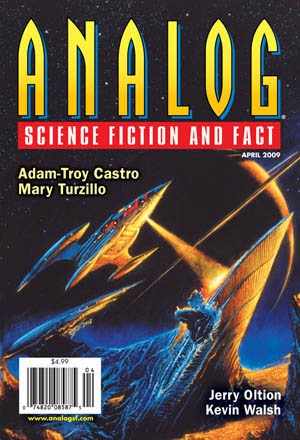
I'm still working my way through my huge backlog of Analog Magazines. Next up is the April 2009 issue. The cover looked promising...winged spaceships with a ringed planet (Saturn maybe) as a backdrop, however none of the stories inside had anything to do with winged spaceships or ringed planets. There wasn't much science in the fiction in the issue either and the fact was a little thin as well, but that doesn't mean the stories inside aren't worth reading. My thoughts on a few of the more interesting stories and articles follows...

Gunfight On Farside, by Adam-Troy Castro is this issue's lead Novella. The story kept my attention all the way through and was entertaining. There has only ever been one "gunfight" on the moon and, in a way, this is the story of what happened there and many years after. The secret isn't what happened so much as what was never revealed, and why. As I said this was an entertaining read, even though the "secret" was easy enough to guess well before the story ended. Of course, in the end this was much more of a fantasy than a science fiction story...but you'll need to read it to find out why that is so.

Steak Tartare and the Cats of Gari Babakin, by Mary Turzillo was the next story in this issue, a novelette set on a well colonized Mars. Turns out a domed town...Gari Babakin...has had an infestation of Trixoplasma gondii. Cats do carry this parasite and it is communicable to humans that much is fact. That is makes human females sexy and smart while making human males slovenly drunkards and making both sexes frivolous and "inefficient" is...well, I doubt that's particularly factual, but an interesting hook to hang a plot upon. The citizens of Gari Babakin are happy, creative and productive, but the rest of the Martians have to take care to not become "infected" by them, and so their products aren't as widely used or as good as they could be. So, the corporation that owns Gari Babakin "right down to the last molecule" sends a delegation to secretly "infect" the colony with a viral agent to "free them of their parasites...and kill their cats! The citizens of Gari Babakin find a way to retain their culture, and get their revenge upon the rest Mars while they are at it. I found it interesting that this story really seemed to be about a tension between creativity and efficiency...sometimes you need a little inefficiency to create.

Foe, by Mark Rich, another novelette set on a well colonized Mars was, in my opinion the best story of the issue. Mr. Rich's name didn't make the cover, but I enjoyed his story more than any other. Foe dealt with the a very similar idea as the previous story....productivity vs. efficiency. A new Department Chief for the Office of Efficiency has just arrived at Dometown 26. He soon discovers that he now the "Face of Efficiency"...the Foe of everyone in the town. A little investigation and he decides that if he does his job well he'll be fired, or forced out, like the previous 16 Foes of the last 30 years and if he does a poor job he'll also be forced out or fired. Being sent from Earth to Mars, he isn't going to be sent back to Earth so he'll have to find another job here, and if he is unversalily disliked who will hire him? He decides to introduce inefficiencies into the system here and there to get himself fired, but do so in a way that will make him friends...or at least no enemies. Much to his surprise he discovers that the inefficiencies he is introducing...forcing an overworked manager to take a 15 minute break, allowing a 'crazy old bum' to paint a small section of the dome blue so it will like like an Earth sky, sending a worker home to practice her violin instead of working on reports that her boss has been pestering her about, requiring all the workers to stop work and attend a concert in the park...are having the opposite effect from what he expected. The manager is less grumpy and gets more done, the worker feels so much better after practicing for that concert that she comes in early the next day and able to focus on the reports gets them all done. The entire town's efficiency and productivity goes up with his introduction of inefficiencies into the system. In my experience, the old adage of "All work and no play makes Jack a dull boy" is a truism that management too often forgets. Yes, I did enjoy this story especially when our hero changes his office door so his IN/OUT sign makes his office The Office of IN Efficiency whenever he is at work.

The rest of the issue was so-so. The short stories in this issue weren't very strong, and I can't really recommend them. The science fact article dealt with "Ribbonworlds", tidally locked worlds that may be habitable. I'll admit to skimming it, but it did make we want to run out and run a Traveller role playing game. The Alternate View article was a review of "cold fusion" which the author opines as a real effect whether mainstream physics wants to accept it or not.

All in all, a collection of stories worth reading.

Sunday, February 7, 2010

Phoenix, by HG Stratmann

The October 1998 Analog certainly has a mixed bag of stories. "Phoenix", by HG Stratmann, was certainly not to my liking. The short story was one long extended string of puns, all related to tobacco in general and cigarettes in particular. The main character, an expectant mother with a 2 pack a day habit is visited by a "man from the future" who begs her to not quit, but to increase her smoking, because her unborn baby's dna was changed by her habit and that leads him to become the inventer of...oh, let's see...faster than light travel, gravity control, etc, etc, etc. So, she hides her habit from her husband, has her baby, and dies of cancer 9 years later.

The baby, toddler, young boy is constantly pushed and prodded by his mother to show his genius...and then berated when he doesn't live up to her expectations. She dies thinking he, and she, was a failure. The boy, on the other hand, carrying a massive load of guilt from having his wished that his mother would just die and having it come true, does go on to become the inventor of all the above. Story ends...and what was the point? Er, that smoking can cause genetic mutations in fetuses, that smoking leads to cancer and early death, that pushing a child, any child, is often counter productive, or that guilt is a wonderful motivator? Or perhaps the point was just that Mr. Stratmann wanted to impress us with the clever way he was able to insert his many tobacco puns into a time travel story?

This was the second "time-travel" story I read from this issue, O'Carolan's Revenge was the first. This one was several steps down, and I count it as an hour wasted. Sorry, oh so clever, Mr. Stratmann.

Sunday, January 31, 2010

Trade Warriors

The novelette, "Trade Warriors" by F. Alexander Brejcha, in the October 1998 issue of Analog. Is the sort of story I subscribe to Analog for, interesting ideas, not just in science and technology, but also in thought. This story I highly recommend to my readers.

Told in a combination of first person present and flashback, this is the story of how Marie Dupree subverted a culture and made a fortune doing it. Dupree is the first and only human allowed to enter the Trade Academy on Korth. The Kroth will only trade with graduates of their Academy and unless Marie can graduate, Earth will not be allowed to trade with the aliens...and the aliens have some expertise the humans really, *really* want. A completely male dominated society, the femmes movement on Eartth insisted that it be a human female who entered their training program. True to the name of the story, and the nature of the Korthans, their trade academy is run as a cross between "the best of a Marine boot camp and Harvard Business School." For any human to succeed would be very hard, for a human female even harder. Although it is only speculation on my part, I think it is clear there was also a strong segment of Korthan society that wanted the human alien to fail, although it was a minority...at first. Of course, Marie does not fail...hooray for humans, and in keeping with the times in which it was written, hooray for feminism.

I enjoyed the alien-ness of the Korthans as portrayed in this tale, both in shape and cultural mindset. Both were just enough outside human norms to be interesting, but close enough to be understandable...and to provide insights into the human condition. Shorter than humans, but more massive, the carnivorous Korthans were aggressive to the extreme in everything they did. I pictured them as a cross between wolves with their social pack structure and bears. One purpose of the Academy was to teach the hyper-aggressive Korthans how to control themselves physically while only tempering their aggression and directing it toward the war of business rather than the business of war. Dupree has to survive physical challenges...ritual fights...that are supposed to stop short of serious injury, but don't always. Although only one is detailed it is clear by the end of the story she has fought many, and by winning her share earned the respect of many fellow Cadets.

Interesting point number one...the Korthans are lower in technology than the humans, generally, so what is it they have that the humans want so badly? Humans have developed a "Jump Gate" technology that allows us to travel to various star systems, however, the radiation produced by the Gates limits their use badly...more than four times and a human dies. The Korthans, lower in technology in many areas, just happen to be very advanced medically...especially in the treatment of radiation sickness. The powers that be on Earth are sure than, working with the Korthans, the problems of "Gate Sickness" can be solved. New technology, cooperation between species, hopeful progress...just my cup of tea!

Interesting point number two...one of requirements for graduation at the Trade Academy is for the Cadet to start a business during their time there. Given only a small fixed amount of capital to start with, they are expected to cover all of their expenses and earn a healthy profit by the time they are ready to graduate. Marie, knowing little about Korth, would seem to be at a disadvantage, but she brings with her a weapon of war...business war, that is...unknown to the Korthans. Multi-level marketing! Yes, my friends, Mary Kay rules!

Given the male dominated society on Korth, coupled with rising wealth and education, the female Korthans are primed and ready to do more than stay pregnent and barefoot in the kitchen. Marie's business gives them their opportunity. She pioneers the concept of females selling jewelry, clothing and cosmetics to other females...and sitting at the top of the pyramid of the first multi-level marketing scheme she rakes in huge profits. The success of Marie's pyramid begins to upset and unsettle the "powers that be" on Korth and they handle her like the Korthans do...they buy her out. She recieves her diploma early, with honors no less, and a very large payout. The Korth leaders will, of course, shut her business down, but as she says to the human sent to retrieve her, "once Pandora opened the box there was no putting anything back inside." Clearly, she has started a revolution and is walking away rich.

The surprising reveal at the end of the story was that she had made an under the table deal with the human feminist movement leader to do just what she did. Marie went in as an agent provocateur, and will reap even bigger rewards upon returning to Earth. To be honest, this wasn't as big a surprise to me as the author probably intended. I suspected something of the sort was going on, just not the connection to the feminist movement. I suspected the Earth Authority, itself, had given her this assignment...but was that because of my 2010 post-feminist mindset?

Interesting point three...1998 was only 12 years ago. Did 1998 Americans, the primary readership of Analog, find it so unusual for a female to be (a) the protaginist in a tale such as this?; (b) to be a savvy and creative business woman; (c) to think that a hundred years hence humanity would still need a femme movement; or that women could, not just compete, but excel in the war of business...or even the business of war? I can see where the female angle of this story would be radical, even today, in some parts of the world...you are wise enough to know where I mean...but in the "West" do we blink twice at a female CEO? Does the "glass ceiling" even still exist? Perhaps, it does, but surely it is shattering and falling away.

You know, I think we can thank Mary Kay, Tupperware and Amway for some of the changes in our view of women in business. Getting a "foot in the door", lead to a "place at the table", and that lead to where we are now. The female CEO's, Senators, and Secretaries of State, stand on the shoulders of their mothers and grandmothers...and I bet more of them fought their revolution, not on the streets but in living rooms and kitchens selling to other mothers, grandmothers and their daughters.

I really enjoyed this story and would love to read more about the humans and the Korthans...and about Marie Dupree.

As an aside, I have discovered that this was one of the last stories that Mr. Brejcha had published in Analog. He has written many stories since, but either he left Analog or it left him behind...a shame either way.

Saturday, January 30, 2010

O'Carolan's Revenge

"O'Carolan's Revenge" was Rick Cook's short story in the October 1998 issue of Analog. This story was much more to my liking than the previous one I read. A "slice of life" time travel story, bittersweet, but satisfying.

The Irish harper, O'Carolan, is an old blind man living at the end of the "great houses" of Ireland. He knows his time on earth is short. He also knows that soon there won't be any hosts to give him shelter and board in exchange for his music, and with the loss of patrons he fears his music will die with himself.

He is approached by a man...a hard horse trader O'Carolan calls him by the name of Johnny Adams...and a woman...Mauve Fitzpatrick...who offer him hospitality for 3 days and nights. For 3 days and nights he plays for his strange hosts and forms a friendship with the woman and fellow harper, Mauve. At the end of the contract, the man pays O'Carolan with a bag of gold and a fine blue cloak, insisting that the harper sign his name to a paper as proof that it was he who played here. Before O'Carolan can sign Mauve rushes in and tells the Irish harper that they are "from the future" where his music is still admired. The songs have been recorded and will be sold to make Johnny rich.

O'Carolan realizes that Johnny is, in his mind, cheating him, but he also realizes that yes his music has lived on far into the future after all! So, the harper signs the contract, but exacts a toll. As Johnny and Mauve sit and listen, without their recording equipment, he plays them a composition that is the most beautiful thing he has every done. He then informs Johnny that he will never play that song again, so it will be lost to him for all time..that is his revenge.

After Johnny leaves frustrated, O'Carolan tells Mauve that she can play that song, that she must take it with her and make it her own. With that he bids his companions goodbye and with his lead boy leaves the ruined castle for the Roscommon Fair three days hence.

This story touches some points that interested me. First, what would be profitable from time-travel is bringing back lost art, music, and performances by long dead artists. Is that fair to the artists of the past? Perhaps, perhaps not. In many, perhaps most, cases an artist isn't "in it" for the money or the fame, but for the art itself and knowing that their art will live on after themselves might be a greater reward than any amount of gold. Suddenly, I am reminded of not one, not two, but many writers, artists, poets and composers who died by their own hand firmly convinced that they were failures...I'm sure you can think of a few. If they could only have seen into the future where their work is enjoyed, even revered, would they have stayed their hand?

Cook's story telling in this story was very good. He set the scene, drew me into his protagonist, and made me care for him. To be honest, I would greatly enjoy reading more about O'Carolan's life, no need for time-travel. I wonder if Rick Cook has gone on to great things? I wonder if he has written more tales of the Harper O'Carolan? I hope he has!

Friday, January 29, 2010

Artifacts by Jerry Oltion

Artifacts was published in the October 1998 issue of Analog. I've read other stories by Mr. Oltion in the past and enjoyed them and this one was well-written and entertaining as well...but I didn't really enjoy it.

The premise is that a few hundred years from now mankind has discovered many, many, hundreds of "artifacts" floating in and around the Solar System. Artifacts left by many different alien species that expanded and contracted and basically killed each other and themselves off over the billions of years before "now." Again with the Fermi Paradox...they were out there, but killed themselves off, and that's why we don't hear from them now.

The story's plot involves a spacer flying a "bomb" ship out to a recently discovered Artifact that is being explored and exploited. Yes, humanity is scavenging technology from these Artifacts, some of them very dangerous and some of the technology equally dangerous. Brian's, the protagonist, ship is ferrying supplies and more scientists out to the "site." Upon arriving the scientists already there act a bit strangely. Their leader shows Brian a "device" that gives him a very vivid virtual reality experience...a disturbing one, but one more strange than sinister.

Later Brian goes off to explore on his own and finds an anpitheater the aliens once used. He experiences another "vision", a flash of a sacrifice. A human sacrifice...and the the scientists arrive holding two of Brian's crew prisioner and he knows they have been "infected" by the technology here and are going to sacrifice his crewmates.

A short fight ends with him running back to the ship where he eventually orders its computer to "launch" even though he know it will kill everyone aboard the ship and the "Artifact"...innocent as well as the guilty, infected as well as the uninfected.

Although Oltion doesn't come right out and write it, it is clearly implied that all religion is an alien infection that leads only to death and destruction. So, fearing he, himself, has been been infected he must kill himself rather than risk a religious idea from making it back to earth. Sacrificing himself...how appropriate.

Science Fiction has been called the fiction of ideas. This story had several interesting ideas, but frankly Oltion lost me by painting religion, any and all religions, as a wholely bad idea.

I am many years behind reading Analog, I remember it as the home for high technology, filled strong men and women and an proponent of "progress." The stories were often very pulpy, but almost always fun. Here's hoping I find some of those stories as I try to read these magazines.

Wednesday, January 27, 2010

The Fermi Plague

I've been a subscriber to Analog Science Fiction and Fact for 40+ years, however, I've fallen almost a dozen years behind in my reading. Yes, I know, I know. :)

In any case, I am going to post comments about stories and articles I read starting with this one... "The Fermi Plague", an Editorial by Stanley Schmidt in the October 1998 issue of Analog.

Dr. Schmidt's title, of course, refers to the big question..."Where is everybody and why haven't they said 'hello?'" That question remains unanswered 11 years later, although we have discovered many, many, planets in the meantime. This question, though, isn't really the thrust of the editorial, and in light of what has happened since it was published, it takes on an even more scary taint.

What Dr. Schmidt asks, is can a techonological civilization...and as we are the only one we know of...can we survive long enough to become the sort of civilization that can contact other civilizations?

Stanley adds "the plague" as a possible answer to Fermi's Paradox. A Technological Civilization may develop the ability to kill itself with a plague.

Dr. Schmidt's example plague was the "Anthrax scare" of the late 90's. That was a phony scare at the time, but it was possible, even then, for a government, even a poor one, to "weaponize" a viral or bacteriological strain and deliver it against population in general. It is even more possible today!

It isn't just governments that could develop and spread such a plague, any well financed NGO...terrorist group...could pull it off. So could any well-heeled individual nutjob! Scary, huh?

After 9/11, the Mumbai Massacre, and all of the other attacks of the last decade it is clear that there are groups in the world willing to indiscriminately kill innocent people and suicide while doing it. All that has been wanting has been the agent of destruction. Crashing airplanes is awful, massacring people in a hotel, on trains, in nightclubs is awful, planting bombs here and there takes out buildings and dozens, hundreds, of people is awful, but non of them would compare to setting off an atomic bomb in downtown London, Paris, New York or Tokyo!

Atomic bombs can be built, and we know who might be building them. Are all of the atomic bombs from the former USSR accounted for? Are we sure? Even short of a bomb, just a conventional bomb...and we know they can build them...could disperse a cloud of radioactive death just from the waste material from power plants. As bad as an A-bomb or a "dirty" bomb would be it wouldn't be a global event...a plague could be.

There are plenty of natural diseases out there that could lay millions low...HINI anyone? And then there are the un-natural ones. There is no evidence that anyone has used our knowledge of DNA and genetics to create killer diseases...yet...but there is no evidence that it hasn't been done in one, or more, government library. If it hasn't been done yet, do you want to bet...can we afford to bet...that it won't be done?

Mankind on Earth is walking on a tightwire. We have been up there for years and will be up there for many, many, more...unless we fall off and then Dr. Schmidt will have been correct about how one Technological Civilization disappeared.

So, what do we do about it? Dr. Schmidt's suggested solution was for all of mankind to become rational, kind-hearted, and stop murdering each other no matter how good a reason we might think we have...in short, the end of fanaticism and the ascendancy of reason. You tell me, in the past 12 years has fanaticism receded or advanced? Sad and scary.